You hop in the car, turn the key or push the start button ... nothing. Or maybe one of your headlights goes out when you're driving at night on a highway. Maybe during a long road trip, your radio decides to just cut out without warning. And if you spend enough time behind the wheel often, chances are, you've been there, where everything seems fine, yet something clearly isn't. More often than not, the culprit is a blown fuse.
So, how can you tell there's a fried fuse in your car? The most obvious giveaway is that the component just stops working. As mentioned earlier, the radio goes out, the lights start flickering, or simply won't switch on, or you can't use your AC. Sometimes, it's the car that won't start, and no amount of jump-starting or rolling it down a hill seems to be helping, which could mean your ignition fuse is toast. In some cases, especially if the fuse box is near the dashboard or in the glove compartment, you might catch a faint burning smell when one pops. Older cars, or those with electrical gremlins, are more likely to blow multiple fuses at once.
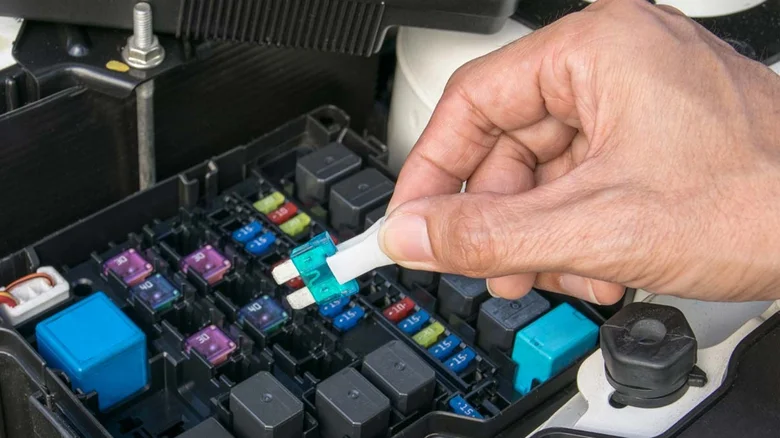
Can you do a quick visual inspection of your fuse and tell? Yes. Most fuses used in cars are translucent. Simply pull one, hold it up to the light, and observe the metal strip inside. If broken or you see a discoloration, it's most likely fried. However, a proper test involves a multimeter.
Some fuses kill the music, others kill the engine
Sometimes you can. Sometimes you can't. It depends on which fuse exactly gave out. If a fuse linked to a non-essential component -- your radio, power windows, or interior lights -- burns out, it's annoying for sure. But your car will still run fine, and you'll even survive countless rides without mood lighting or blasting your favorite playlist. Even so, not all fuses are built the same or have the same importance, and some are responsible for controlling more vital components, like the fuel pump relay or the ignition circuit. When one of these blows, that's a whole different story. It simply means you're parked and not going anywhere until that gets fixed.
What’s worse is that you usually don't know what went wrong until something quits on you. That explains why most people only remember fuses exist after something goes lifeless or mute. And modern cars don't make things any easier. Nowadays, most have multiple fuse boxes, often divided between the cabin and the engine bay. Some are concealed behind trim panels, others under the dash, while some are packed tight with integrated modules or smart relays that aren't user serviceable. So, you could be dealing with more than just a cheap fuse, in which case, repeatedly replacing them won't fix anything -- you're just masking a deeper problem.
Replacing a blown fuse
Luckily, replacing a blown fuse is one of, if not the easiest, DIY fixes on a car, and it doesn't cost much, either. You just need to find the fuse panel, whose location may vary with your car make and model, so you may want to check your owner's manual if it's not obvious. Once you find it, there should be a diagram with information on specific fuses. This should help you match up the fuse with the component that's acting up. Check the amperage rating, usually at the top of the blown fuse, and get a matching replacement. Most auto part stores sell assorted packs for cheap, and having a few spares in your glove box is good insurance. Better to be safe than sorry when the same fuse blows again.
To install the new fuse, simply push it into place, and it should fit neatly without much effort. If it doesn't fit, you've probably got the wrong fuse. Once it's in, test whatever was acting up. If it's working again, great, problem solved. But if the new fuse blows right away or shortly after, something somewhere is drawing too much current. That often points to a short in your car's wiring or sometimes, a faulty aftermarket component like custom stereos or security systems. At that point, unless you're a certified auto-electrician, make a point to involve a pro.